Labeling
Dog Treat Label Requirements: What Must Be Printed on Your Bag
The required label elements for dog treats, which panel each one goes on, what treats can leave off, and how to plan space on your bag before you print.
Updated 7 min read
Quick answer
A dog treat bag needs the brand and product name, the species, and the word "treat" or "snack" on the front, plus the net weight in ounces and grams in the lower third of the front panel. The back or side carries the guaranteed analysis, the ingredient list by weight, and the manufacturer or distributor's name and location. Treats can skip the nutritional adequacy statement and feeding directions.
Getting the label right before you print saves you from reprinting 5,000 bags. This guide covers what U.S. rules require on a dog treat bag, where each element goes, and how to leave room for it on the bag style you choose. It is general information, not legal advice. Confirm requirements with the feed control office in each state where you sell before you approve artwork.
Who sets the rules
Two layers of rules apply to pet treats in the United States:
- Federal (FDA). Federal rules require four things on animal food labels: a proper product identity, a net quantity statement, the name and place of business of the manufacturer or distributor, and ingredients listed by common or usual name in descending order by weight (FDA).
- State (AAFCO model regulations). Most states adopt the pet food model regulations published by the Association of American Feed Control Officials. These add the guaranteed analysis and set where items go on the package. State officials, not AAFCO, review labels and approve products for sale (AAFCO).
Dog treat label checklist
| Label element | Where it goes | For treats |
|---|---|---|
| Brand and product name | Front panel | Required |
| Species (for example, "for dogs") | Front panel | Required |
| The word "treat" or "snack" | Front panel, conspicuous | Required |
| Net quantity in U.S. and metric units | Lower third of the front panel | Required |
| Guaranteed analysis | Front or information panel | Required |
| Ingredient statement | Information panel | Required |
| Manufacturer or distributor name, city, state, and ZIP | Information panel | Required |
| Nutritional adequacy statement | Information panel | Not required for treats |
| Feeding directions | Information panel | Optional |
Front panel (principal display panel)
The front panel is the side shoppers see on the shelf. AAFCO places these items here:
1. Brand and product name
The name has to be accurate. Naming rules depend on how much of an ingredient the treat contains, so "Chicken Dog Treats" and "Chicken Flavor Dog Treats" mean different things. Check the AAFCO naming rules before you finalize a product name that includes an ingredient.
2. Species
Make it clear the treat is for dogs. It can be part of the product name, such as "Peanut Butter Biscuits for Dogs."
3. "Treat" or "snack"
This one matters more than it looks. Identifying the product conspicuously as a treat or snack on the front is what exempts it from the nutritional adequacy statement and feeding directions required on complete-and-balanced foods.
4. Net quantity
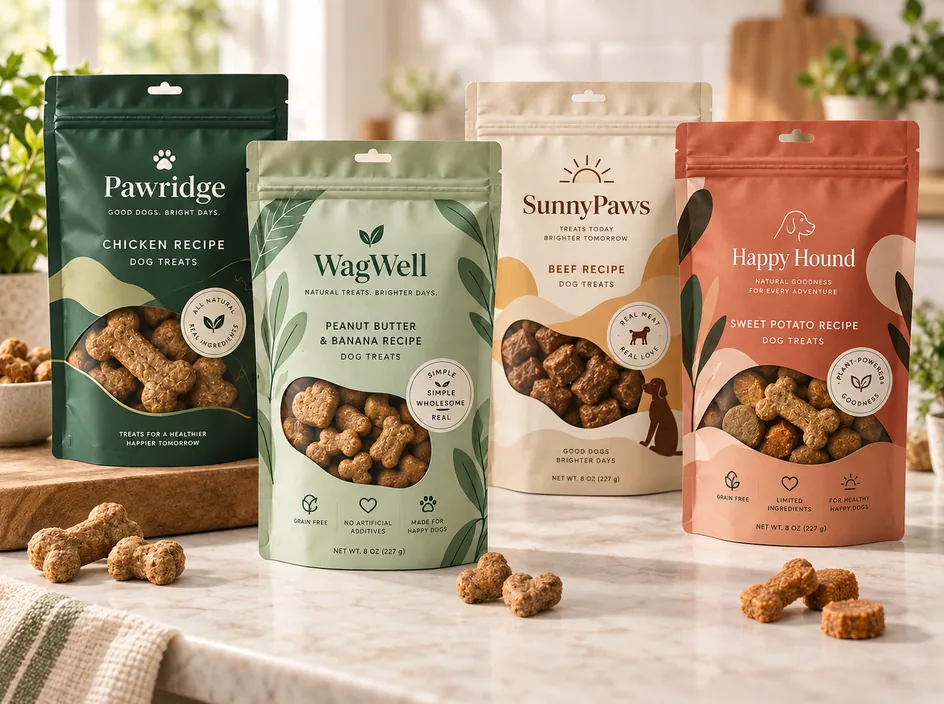
Put the net weight in the lower third of the front panel, in both U.S. and metric units, for example NET WT 8 OZ (227 g). Keep this zone clear of busy artwork and clear windows so the statement stays readable.
Information panel (back or side)
5. Guaranteed analysis
List minimum percentages of crude protein and crude fat and maximum percentages of crude fiber and moisture, in the order and units AAFCO specifies. If your packaging makes a claim about another nutrient, such as glucosamine or omega-3s, that nutrient generally has to be guaranteed too.
6. Ingredient statement
List every ingredient in descending order by weight, using AAFCO-defined names or common or usual names. On treats with long ingredient lists, this is usually the element that runs out of room first.
7. Manufacturer or distributor
Show the company name, city, state, and ZIP code. If a co-packer makes your treats, use wording such as "Manufactured for" or "Distributed by" before your company name.
What treats can skip
- Nutritional adequacy statement. Not required when the product is clearly labeled a treat or snack and does not claim to be complete and balanced.
- Feeding directions. Optional for treats. Many brands still add a short line such as "Feed up to 3 treats per day for a 30 lb dog" because shoppers look for it.
If you do call a treat complete and balanced, both of these become required.
Claims to be careful with
- Disease or drug claims. Saying a treat cures, treats, prevents, or mitigates a disease makes it a drug in the FDA's view, which requires approval before it can appear on a label (FDA).
- Health and function claims. Claims such as supporting joints or dental health need support behind them. Word them carefully and keep documentation.
- "Human grade." Only use it when the whole product meets human-food standards from ingredients through manufacturing. Get guidance before printing it.
Label changes coming: AAFCO Pet Food Label Modernization
AAFCO has adopted updated model regulations, published in its 2024 Official Publication, that bring a Pet Nutrition Facts box closer in style to human food labels, an intended use statement on the front panel, and standardized handling and storage instructions. AAFCO recommends a six-year transition for companies to update their packaging (AAFCO).
Which parts apply to treats, and when your states will enforce them, is worth confirming with your state feed control office. If you are designing bags now, leave extra room on the information panel so a future label update does not force a new bag size.
Plan space on your bag before you print
Required text takes more room than most brands expect, especially on small treat bags. The bag style decides how much space you have:
- Stand-up pouches give you a front and back panel. The front carries the name, "treat," species, and net weight. The back holds the guaranteed analysis, ingredients, and company info.
- Flat bottom bags add two side gusset panels and a printable bottom, which gives long ingredient lists and feeding suggestions plenty of room.
- Lay-flat pouches and small samples have the least room. Size the pouch around your label copy, not just your fill weight.
- Custom shaped pouches lose print area to the die-cut outline, so test your copy on the real dieline.
A few more tips from bag layouts:
- Keep required text off clear windows and out of seal areas and zipper tracks, where it can be cut or hidden.
- Leave a clear spot for the lot code and best-by date, which are usually printed when bags are filled.
- Use strong contrast for required text. Small type on busy photos is hard to read.
Our free design support includes dielines and layout help, so every required element has a home before you approve a proof. See bag styles and standard sizes or custom dog treat packaging.
Frequently asked questions
Do dog treats need a guaranteed analysis?
Yes. Under the AAFCO model regulations most states follow, treats still list a guaranteed analysis with minimum crude protein and fat and maximum crude fiber and moisture.
Do dog treats need feeding directions?
No, as long as the treat is not labeled as complete and balanced. Feeding directions are optional for treats, though many brands add a simple suggestion such as how many treats per day by dog size.
Do dog treats need a nutritional adequacy statement?
Not if the package conspicuously identifies the product as a treat or snack on the front panel and does not claim to be complete and balanced.
Does AAFCO approve pet food labels?
No. AAFCO writes model regulations, but state feed control officials review labels and approve products for sale in their states. Check with the states where you will sell.
Does net weight need both ounces and grams?
Yes. The quantity statement goes in the lower third of the front panel and shows both U.S. units and metric, for example NET WT 8 OZ (227 g).
Sources: AAFCO labeling requirements, AAFCO Pet Food Label Modernization, FDA animal food labeling and pet food claims. This guide is general information, not legal or regulatory advice.